
Managed website service, run by people
Website as a service for home service businesses. We build your site, then run it every month: hosting, backups, updates and the edits you send.
What every launch build includes
Before anything goes live, we agree the pages, the price on the page and the path to a call with you.
-
Custom design, no templates
Built around your services and how your customers call.
-
Page copy written for you
You check the facts. We do the writing.
-
SEO setup and schema markup
Service pages structured for search from day one.
-
Built for phones first
Speed tuning, so the page loads before the customer gives up.
-
Analytics and Search Console
Google Analytics and Search Console set up and connected.
-
Google Business Profile linked
Your site and your profile point at each other.
What a launch build could look like
A sample concept for a painting company, on a desktop and a phone.
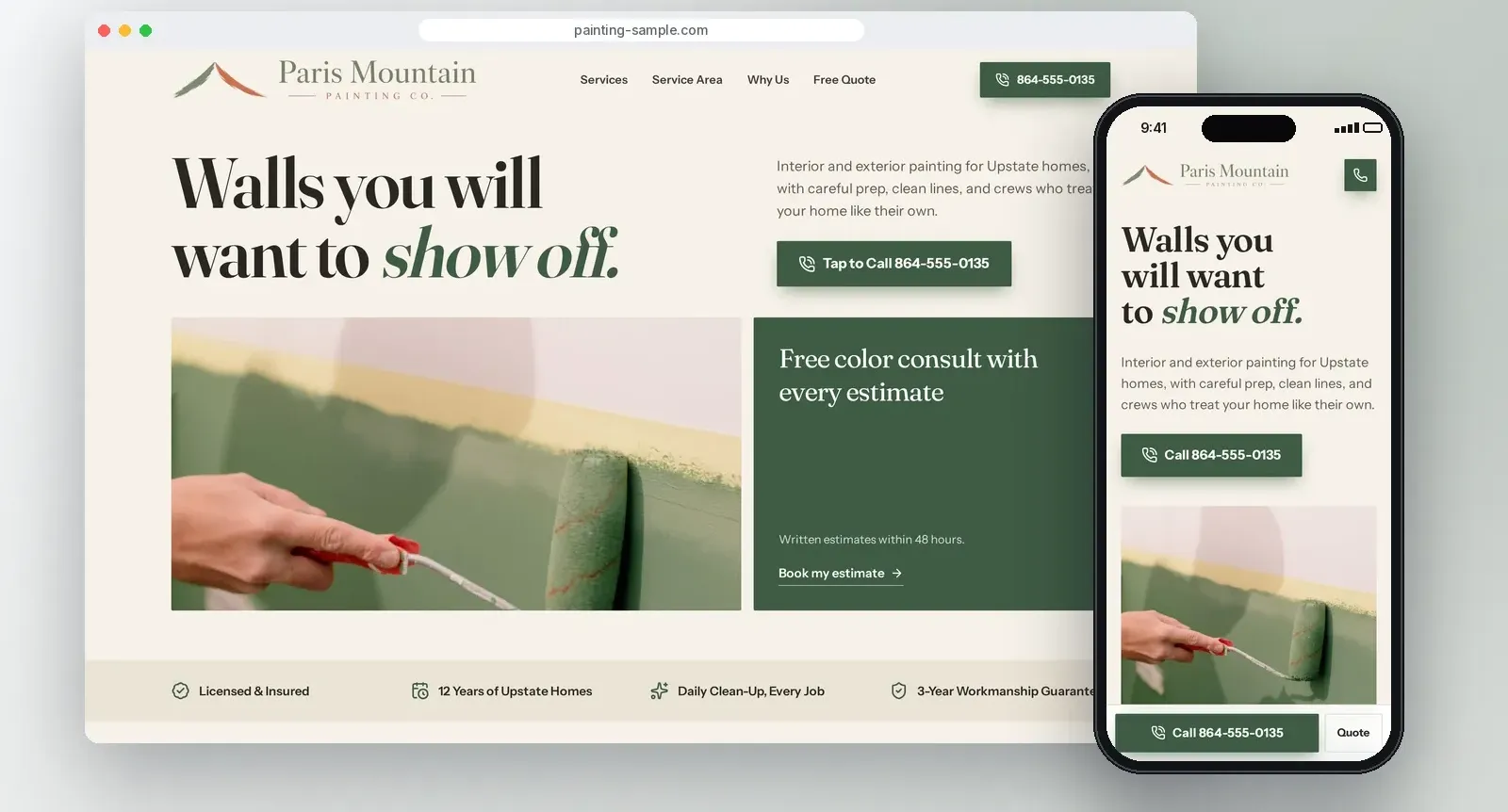
Painting
What happens every month
Small business website management without the dashboard, counted out so you know what you pay for. You email a change; a person on our team makes it, and every request gets a reply within 1 business day.
- Unlimited
Small edits
Made by a person on our team. Every plan.
- Monthly
Hosting, backups and updates
Handled for you. Every plan.
- Weekly
Google Business Profile posts
Written and posted for you. Local and Growth.
- 1 or 2
New service or town pages a month
A new page for a service or a town you want to be found in. 1 a month on Local, 2 on Growth.
- 1 page
Monthly report
What we did and what changed, in plain words. Local and Growth.
- 1 business day
Reply time
Every message and change request gets a reply from a person. Every plan.
- About 100
Review requests a month
Up to about 100 a month, with review replies handled for you. Growth.
- Up to 3
Call tracking numbers
So you can see where your calls come from. Growth.
- $0
Launch fee
You pay the monthly price and nothing up front.
Month to month. Cancel anytime.
No launch fee to lose and no minimum term to sit out. Ask us how handover works. Site is $199 a month, Local $399 and Growth $799.
Managed Website Plan questions
What does the plan cost?
Three plans: Site at $199 a month, Local at $399 and Growth at $799. No launch fee. See pricing for what each plan includes.
How many edits can I send?
Unlimited small edits. A person on our team makes them, and every request gets a reply within 1 business day.
What counts as a small edit?
Changes to the site you already have: text, photos, hours, service details and prices, or a new section on an existing page. Redesigns, new features and extra pages beyond your plan are quoted separately, and we tell you before any work starts. The new service or town pages in Local and Growth are included.
What is included when you build the site?
Custom design, page copy written for you, SEO setup and schema markup, speed tuning for phones, Google Analytics and Search Console, and your Google Business Profile linked. More on the Managed Website Plan page.
What happens each month?
On every plan we host, back up and update the site and make the changes you send. Local adds weekly Google Business Profile posts, Google Business Profile photo uploads and profile updates, 1 new service or town page a month, a one-page monthly report with a local ranking map, and a review QR card and review link at launch. Growth adds 2 new service or town pages a month instead of 1, a 20-minute monthly call (booked by link) to review leads and next changes, a seasonal promo page each quarter on top of those 2 pages, one postcard design a year (printing billed separately), missed-call text back, lead alerts with one inbox for calls and forms, review requests (up to about 100 a month) with review replies handled for you, a past-customer review push at launch, call tracking with up to 3 tracking numbers, and automatic quote follow-up texts and emails.
How long does it take to launch?
Usually about two weeks from when we have your information: your services, the areas you cover and how customers should reach you. That is a target, not a guarantee, and larger sites can take longer.
I paid an agency before and could not tell what they did. Why is this different?
You see the full price before you talk to us. There is no launch fee and no minimum term. The monthly work is listed in plain words, and on Local and Growth you get a one-page report each month. If it stops being worth it, cancel.
What happens if I want to leave?
Every plan is month to month, so you can cancel anytime. You never paid a launch fee, so there is nothing up front to lose. Ask us how handover works.
Who will I deal with?
Kyle Melton. He and his wife, Christina, are the team behind Melton Studios, and Kyle handles your site day to day. Email hello@meltonstudios.com or use the contact form, and you get a reply within 1 business day.
How is this different from an AI website app?
People build and run your site. You send a change and a person makes it. The website is the whole job, not one feature in an app.
Ready to mark out your site?
Tell us what you do and where you work. A person replies with next steps.